

I get lots of bikes in the workshop that have been ‘excessively lubricated’.
Lots of buildup of lube and trail gunk on the chain.
Jockey wheels that don’t work correctly because of heavy contaminant buildup.
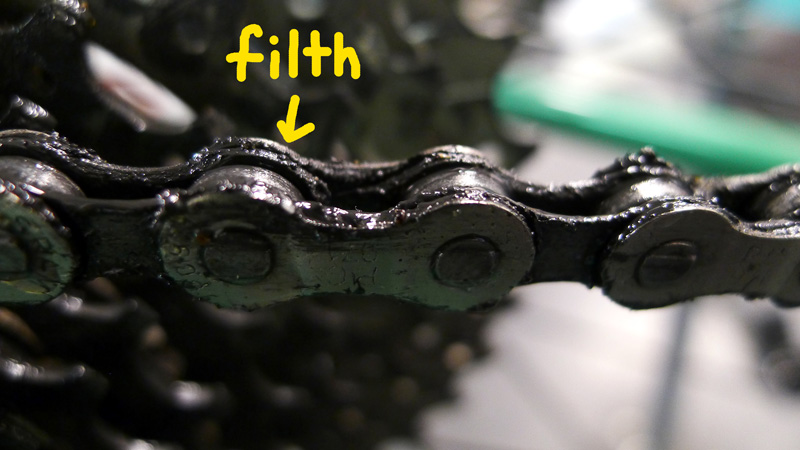
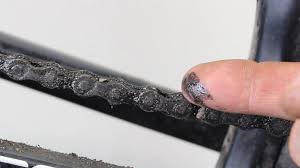

Worse still, the lubricant has often spread right across to the other side of the wheel
and contaminated the brake system.
As with all aspects of bicycle maintenance, there’s a range of ways to get your drivetrain lubricant right, and here’s my tips.
Understanding the reason for lubricant is important – your primary goal is to get lubricant inside the pin & roller assemblies where the wear occurs. The secondary goal is to coat the outside of the chain to improve the way it meshes with the chainring and cassette teeth. It’s also a barrier to contaminant ingress.
The best form of chain lubrication is hot waxing. I’ve tried to think of a scenario where it’s not the best idea and with the exception of riding from Cairo to Capetown (G’day Muz!), I can’t think of one. It’s more work at home for less work on the trails though, so it’s not for everyone…yet.
Wax-based ‘dry’ lubes are better for MTB and Gravel than ‘wet’ lubes. A lube that penetrates and then sets will not attract contaminants like a wet lube. Riding a muddy event with a wet lub will often see your chain run cleaner and clog less.
Never lubricate a dirty chain. More lube will stick the trail contaminants in place and create grinding paste. This will wear all of your drivetrain components quickly and you’ll have an unexpected bill at the bike shop. Plus it won’t improve the drivetrain performance (see item #5).
When I’m at an event doing mechanical support, there’s always someone that comes up to me half-way through the race and asks me to lube their muddy/dusty/dirty/shitty chain. I always say no because
A – never put lube on a dirty chain, and
B – if you’re at a 30km MTB race that you knew would be muddy/dusty/dirty/shitty and you didn’t prepare your drivetrain for that then the problem is you. I don’t carry a tool to fix that.
Always lube a clean and dry chain. When you get home from a ride and clean your bike, scrub the chain and hose it off then take the bike for a short dry ride. Then it’s ready for lubricant.
Chain lube is not the solution for poor shifting. If your bike is having shift problems it’ll be because it’s not tuned correctly. Adding lube adds zero value, look for a mechanical solution.
Chain lube should always be dripped onto a moving chain. When the chain is clean and dry, flip your bike upside down or hang it in a stand and drip lube onto the chain while you’re turning the pedals. When the chain has done a full rotation, that’s enough. It will sort itself out as you ride.
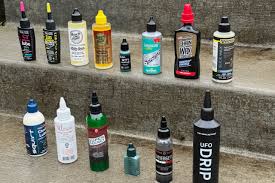
WD-40 and aerosol lubricants must not ever be used on a bicycle. I know, there’s a picture of a bike right there on the can but that doesn’t mean it’s OK. If you spray lubricant onto your bike IT WILL GET INTO THE BRAKES. Here is a picture of 14 different chain lubes and they are all dripped on.
You’ll notice that WD40 is not in this photo.
No, you can’t use the chain lube from your dirt bike on your MTB. Moto chains spin at much higher speed than a bicycle chain so they use a sticky ‘no-fling’ formula. Moto chain lube is the second-worst thing you can put on your bicycle chain.
Rotating two chains periodically will improve the lifespan of your drivetrain. Using a worn chain will wear the other drivetrain components, primarily the cassette. Rotating two chains slows the wear process.
Here’s how we do that:
– Buy one new cassette and two new chains cut to the correct length. Also get 6 clip-links.
– Run chain #1 for 200kms (or 5-8 rides) and next time you clean your bike, remove chain #1 and fit chain #2 with a new clip-link.
– Clean and dry chain #1, put it in a small ziplock bag and squirt in the chain lube. Leave it there until you swap chains again.
– Keep rotating the chains until you run out of clip-links then go to the bike shop and buy some more.
– When both chains are worn to 1mm, the process is complete. Recycle the scrap and start again.
Chaincheckers are awesome. You should definitely have one.